

Roman Austin | March 18, 2026 | Bicycle Accidents
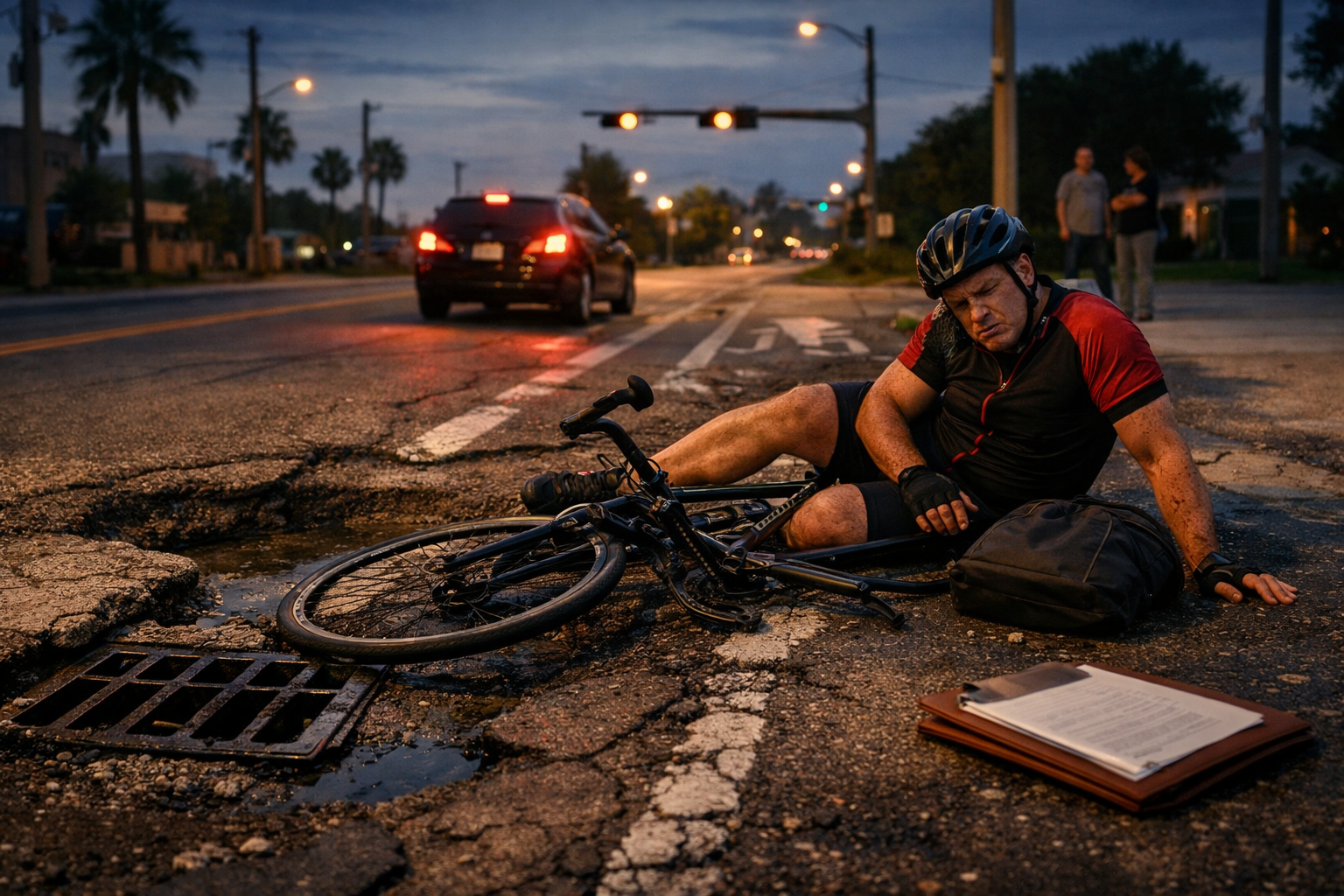
Tampa joined the Vision Zero Network in 2020 and launched a full action plan in 2022, committing to eliminate all roadway fatalities and life-altering injuries. But cyclists across Tampa still ride on roads that lack protected bike lanes, have poorly lit intersections, and feature pavement riddled with potholes.
When a road defect causes a bicycle accident, Florida law may allow you to hold the City of Tampa accountable. The process for suing a government entity follows a completely different set of rules than a standard personal injury case, though, and missing a single procedural step may end your claim before it starts.
If you were injured in a bicycle accident caused by a hazardous road condition in Tampa, speaking with an attorney experienced in government liability claims can help you evaluate your options and next steps.
Key Takeaways for Bicycle Accident Claims Against the City of Tampa
- Florida’s sovereign immunity doctrine limits when and how you may file a personal injury claim against a government entity, but Florida Statute §768.28 partially waives that immunity for certain negligence claims involving operational failures.
- Damage caps on government liability claims are currently set at $200,000 per person and $300,000 per incident, far lower than what you might recover from a private defendant.
- You must submit a written pre-suit notice to the city before filing a lawsuit, and failing to follow this mandatory process may permanently bar your claim.
- Florida law distinguishes between protected planning-level choices and day-to-day operational failures like neglecting road maintenance, and only the latter may support a bicycle accident claim.
- Tampa’s own Vision Zero program acknowledges a High Injury Network of roads where severe crashes concentrate, which may serve as evidence that the city had knowledge of unsafe conditions.
What Is Sovereign Immunity and How Does It Apply to Bicycle Crashes in Tampa?
Sovereign immunity is a legal doctrine that traditionally shields government entities from lawsuits. Florida has partially waived this protection through Florida Statute §768.28, which allows tort claims against state and local government entities under limited conditions.
How the Waiver Works
The waiver applies when a government employee’s negligent act or omission, performed within the scope of their employment, causes injury under circumstances where a private person would also be liable.
For bicycle accidents involving dangerous road conditions in Tampa, this means the city might face liability if a city department failed to maintain or repair a public road and that failure led to your crash.
The waiver comes with significant conditions, though. The statute imposes damage caps, pre-suit notice requirements, and procedural steps that do not apply to lawsuits against private defendants.
The Discretionary Function Distinction
Florida courts recognize an additional layer of protection beyond the general rules of §768.28. Under the discretionary function doctrine, government decisions involving planning, policy-setting, or resource allocation are generally immune from liability, even when those decisions cause harm.
This distinction matters significantly for bicycle accident cases. If the City of Tampa made a broad planning decision about where to allocate its road-improvement budget, that choice is likely protected. However, if city crews were assigned to repair a known pothole and failed to do so, that operational-level failure may fall outside the doctrine’s protection.
The line between a protected planning decision and an actionable operational failure is not always obvious. Courts examine the specific facts, including:
- Whether the government entity had established maintenance policies or inspection schedules
- Whether employees followed those policies or deviated from standard procedures
- Whether the failure involved routine day-to-day upkeep rather than high-level policy judgment
- Whether the entity had prior notice of the specific hazard through complaints or crash reports
This distinction is one of the primary reasons government liability bicycle accident claims require careful legal analysis and thorough factual investigation.
What Road Conditions in Tampa May Support a Claim Against the City?
Not every pothole or rough patch of pavement gives rise to a valid claim. To pursue a bicycle accident lawsuit against the City of Tampa for dangerous road conditions, you generally need to show that the city knew or reasonably had reason to know about the hazard, failed to address it within a reasonable time, and that the hazard directly caused your crash.
Common Defects That Lead to Cyclist Crashes
Tampa’s road network includes heavily trafficked arterials, neighborhood streets, and corridors identified on the city’s own High Injury Network. Cyclists face unique risks because even minor defects that a car might absorb without issue may cause a bicycle to lose control instantly.
Conditions that frequently contribute to bicycle accidents include:
- Deep potholes or uneven pavement at the edge of travel lanes where cyclists typically ride
- Missing, faded, or obstructed bicycle lane markings that force cyclists into mixed traffic
- Drainage grates with slots running parallel to the direction of travel, which trap bicycle tires
- Lack of adequate lighting at intersections and along corridors with heavy cyclist traffic
- Construction zones with no signage or detour routes for bicycle traffic
Each of these defects may support a claim if the hazard traces back to a failure in day-to-day maintenance rather than a protected high-level planning decision.
How Tampa’s Vision Zero Data May Factor Into Your Case
Tampa’s Vision Zero Action Plan includes a High Injury Network (HIN), which maps the corridors where the majority of the city’s severe and fatal crashes occur. From a legal perspective, the HIN data may work in your favor.
If the city’s own records show that a road segment has a history of bicycle crashes, it becomes harder for the city to argue it had no knowledge of the danger. A documented high-crash corridor, combined with a failure to address a known hazard, may strengthen your argument that the city’s negligence at the operational level contributed to your crash.
Pre-Suit Notice Requirements Under Florida Statute §768.28
Before you file a lawsuit against the City of Tampa, you must follow a mandatory pre-suit notice process outlined in §768.28(6). Skipping or mishandling this step may permanently bar your claim.
How the Process Works
The statute requires you to submit a written claim to the appropriate government agency. For claims against a municipality like the City of Tampa, you send your notice directly to the city. For claims against state agencies, you must also send a copy to the Florida Department of Financial Services.
Once the agency receives your notice, it has six months to investigate and either deny your claim in writing or attempt to settle. If the agency does not respond within that window, the law treats the silence as a denial, and you may then proceed with filing a lawsuit.
Deadlines and Disclosure Requirements
The statute of limitations for tort claims against a Florida government entity is four years from the date the claim accrues under §768.28(14), but the pre-suit notice itself must be submitted within three years. Those overlapping timelines create a narrower effective window than most injured cyclists realize.
As part of the statutory process, §768.28(6)(c) also requires you to provide certain personal information. These disclosure obligations include:
- Your date and place of birth and Social Security number
- A statement disclosing any outstanding unpaid fines, fees, or judgments exceeding $200 that you owe to the state or its subdivisions
- If no such unpaid obligations exist, a statement confirming that fact
The statute includes consequences for incomplete or inaccurate disclosures. A court may impose double the amount of any undisclosed judgment if the failure to disclose is not excused. These requirements apply during the statutory claims process and may need to be satisfied before settlement, the close of discovery, or the start of trial, whichever comes first.
What Damages May Be Available in a Government Liability Bicycle Accident Claim?
Bicycle crashes often produce severe injuries because riders have no structural protection from impact. Broken bones, traumatic brain injuries, spinal cord damage, and road rash requiring skin grafts are among the injuries Tampa cyclists suffer when a road defect causes a crash.
Compensatory Damages and Statutory Caps
If you file a successful claim against the City of Tampa under §768.28, you may recover compensatory damages including medical expenses, lost income, pain and suffering, and property damage to your bicycle and equipment. Punitive damages are not available against government entities under Florida law.
Recovery is capped at $200,000 per person and $300,000 per incident. When your damages exceed the cap, you may petition the Florida Legislature through the claims bill process, a separate legislative measure where lawmakers review the facts and decide whether to authorize additional payment.
The Legislature is not required to approve a claims bill, and many go unfunded. This uncertainty reinforces why thorough documentation matters from the very beginning of a government liability bicycle accident claim.
How Roman Austin Car Accident and Personal Injury Lawyers Helps With Tampa Bicycle Accident Claims
Filing a bicycle accident claim against the City of Tampa follows a different process than a standard personal injury case. The rules are stricter, the deadlines are shorter, and the claim involves formal pre-suit steps that most injured cyclists have never encountered.
Investigating Road Defects and Identifying Liability
Roman Austin Car Accident and Personal Injury Lawyers works with bicycle accident victims throughout the Tampa Bay area who have been hurt because of dangerous road conditions. When a road defect contributes to a cyclist injury, the claim may involve the City of Tampa, Hillsborough County, or the Florida Department of Transportation (FDOT), depending on which entity maintains the road where the accident happened. Identifying the right government entity is one of the first and most consequential steps, because sending your pre-suit notice to the wrong agency may cost you your entire claim.
A strong government liability case depends on physical evidence that fades quickly after a crash. Roman Austin’s team works to gather time-sensitive documentation, including:
- Photographs and measurements of the road defect at the crash location
- City maintenance records and prior repair requests for that stretch of road
- Tampa’s High Injury Network data identifying known dangerous corridors
- Traffic engineering reports and sight-line assessments at the road segment
- Witness statements from other cyclists or residents who have encountered the same hazard
Road crews may repair a defect days or even hours after a reported crash, which is why early evidence collection is one of the most time-sensitive parts of any dangerous road bicycle accident claim in Tampa.
FAQs About Suing the City of Tampa for a Bicycle Accident
Does sovereign immunity completely protect the City of Tampa from bicycle accident lawsuits?
No. Florida Statute §768.28 partially waives sovereign immunity and allows tort claims against municipalities when negligence at the operational level causes injury. However, the waiver applies only under specific conditions and comes with damage caps and mandatory pre-suit notice procedures.
How long do I have to file a bicycle accident claim against the City of Tampa?
You must submit a written pre-suit notice within three years after your claim accrues. After the agency denies your claim or the six-month review period expires, you have until the four-year statute of limitations to file in court. Because these overlapping timelines create a tighter window than they appear, starting the process promptly protects your ability to file.
What is the difference between a discretionary function and an operational failure?
Florida law protects government entities from liability when they make broad planning or policy decisions, even if those decisions lead to harm. However, when a government entity fails to carry out routine maintenance, repair a known hazard, or follow its own established procedures, that operational-level failure may support a personal injury claim. The classification of the government’s action or inaction often determines whether a bicycle accident case moves forward.
What if I am not sure which agency maintains the road where I crashed?
Roads within Tampa city limits may be maintained by the city, Hillsborough County, or FDOT. Public records and maintenance agreements typically clarify which entity is responsible. Sending your pre-suit notice to the wrong agency does not satisfy the statutory requirement, so accurate identification of the liable entity is a necessary first step.
Does Tampa’s Vision Zero program affect my bicycle accident case?
The Vision Zero program does not create a separate legal claim on its own. However, the city’s High Injury Network data and internal reports may serve as evidence that Tampa had knowledge of dangerous conditions on the road where your crash occurred. If the city identified a corridor as high-risk but failed to act on that information, it may support your argument that the city’s negligence contributed to your injuries.
Take Action After a Bicycle Accident on a Dangerous Tampa Road
Riding a bicycle in Tampa requires trust that the roads beneath your wheels are reasonably safe. When the city fails to maintain its infrastructure and a cyclist gets hurt as a result, Florida law provides a path forward, but it is one with narrow filing windows, mandatory procedures, liability caps, and legal distinctions between protected planning decisions and actionable operational failures.
If a dangerous road condition in Tampa caused your bicycle crash, contact Roman Austin Car Accident and Personal Injury Lawyers for a free consultation, available 24/7.


