

Roman Austin | March 18, 2026 | Commercial Vehicle Accidents
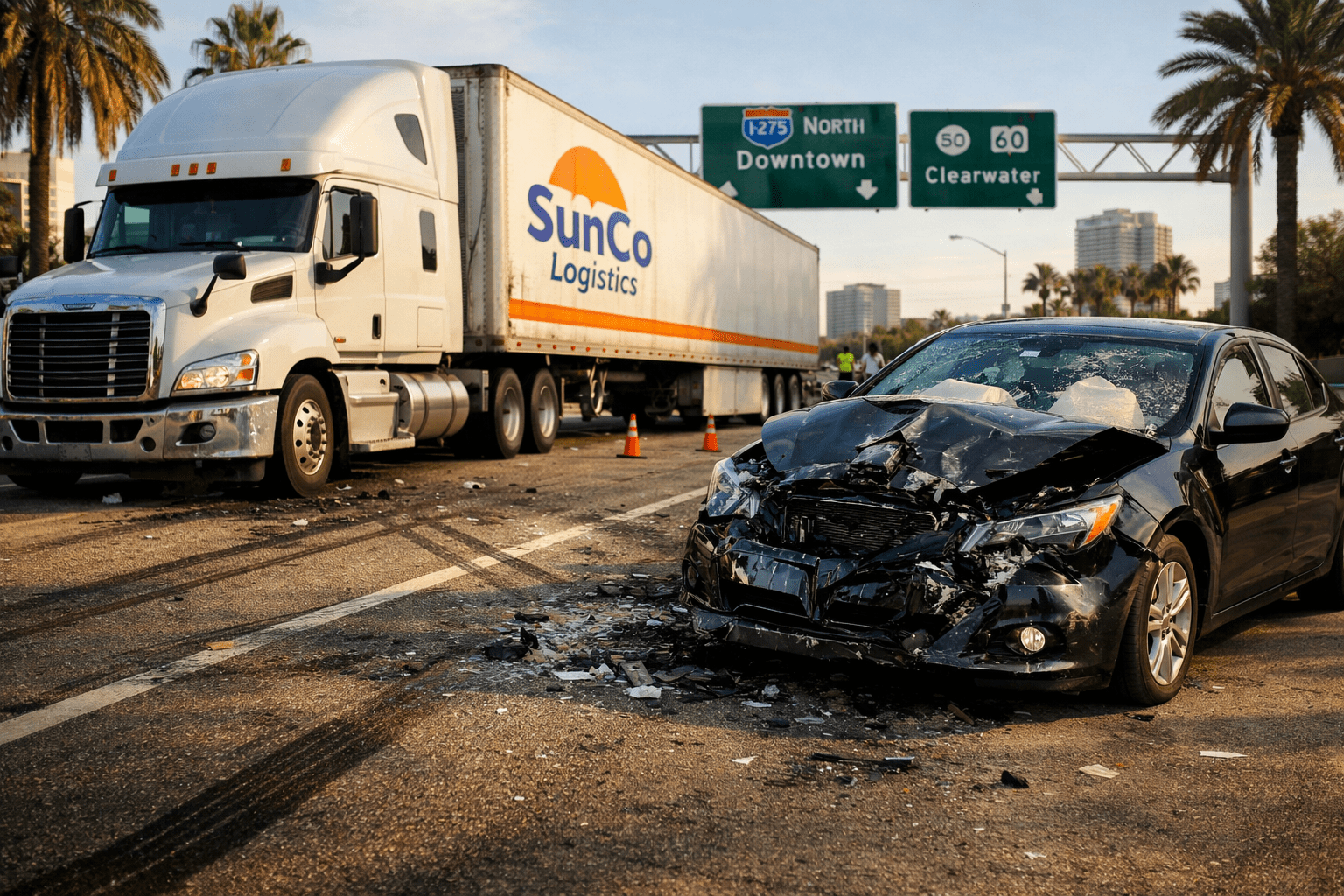
After a truck accident in Tampa, insurance adjusters often steer the conversation toward the driver and the driver alone. That framing benefits the carrier, because the driver’s personal policy limits are almost always a fraction of what the company holds.
The truck driver may have caused the collision, but the trucking company may bear independent legal liability for what happened and why. Suing a trucking company in Tampa, Florida opens the door to larger insurance coverage, stronger evidence of systemic negligence, and a broader set of legal theories than a claim limited to the individual behind the wheel.
If you or a loved one has been impacted by a commercial truck crash in Tampa or Hillsborough County, speaking with a Tampa truck accident attorney may help you better understand your legal options.
Key Takeaways About Trucking Company Liability in Tampa
- Florida law recognizes multiple independent legal theories for holding a motor carrier liable after a crash, including respondeat superior, negligent hiring and retention, negligent entrustment, and negligent maintenance.
- Most interstate trucking companies must carry minimum liability coverage of $750,000 under federal regulations, which is typically far more than an individual driver’s personal policy.
- Under Florida’s dangerous instrumentality doctrine, the owner of a commercial vehicle may face liability when someone operating the vehicle with permission causes a crash, even absent any wrongdoing by the owner itself.
- A trucking company may attempt to avoid liability by classifying its drivers as independent contractors, but Florida courts look beyond the contract label to examine the actual level of control the company exercises over the driver’s work.
How Roman Austin Handles Motor Carrier Liability Claims in Tampa
Pursuing a claim against a trucking company is a fundamentally different process than filing a claim against an individual driver. The carrier typically has a corporate legal team, a dedicated claims department, and an insurer with deep resources. Matching that level of preparation requires a legal team that knows where to find the evidence and how to connect it to the company’s own failures.
Roman Austin represents truck accident victims from its Tampa office at 401 E. Jackson Street, Suite 3319, Tampa, FL 33602. The firm pursues trucking company negligence lawsuits throughout Hillsborough County and the broader Tampa Bay region, including cases that may proceed through the Hillsborough County Circuit Court.
Targeting the Carrier’s Own Failures
A truck accident lawsuit against a Tampa-area carrier may involve multiple claims running in parallel. Roman Austin’s approach to these cases typically includes investigating:
- The company’s driver screening and hiring records to determine whether it failed to identify a history of violations, substance abuse, or license suspensions
- Internal dispatch communications and scheduling records that may reveal pressure on drivers to exceed federal hours-of-service limits
- Vehicle maintenance logs and inspection reports that may show a pattern of deferred repairs or ignored defects
- The company’s compliance history with the Federal Motor Carrier Safety Administration (FMCSA), including prior safety violations, out-of-service orders, and audit results
- Corporate training records that may reveal gaps in driver safety education or ongoing supervision
Each of these threads may lead to an independent basis of liability against the carrier, separate from whatever the driver did wrong at the moment of the crash. If you have questions about whether the trucking company in your case may share liability, Roman Austin offers free consultations around the clock to help you understand your options.
What Legal Theories Support a Trucking Company Negligence Lawsuit in Florida?
Florida law provides several distinct legal theories for holding a trucking company liable after a crash. Each theory targets a different type of company conduct, and more than one may apply in the same case.
Respondeat Superior
Respondeat superior is a legal doctrine that holds an employer responsible for the negligent acts of its employees when those acts occur within the scope of employment. The Latin phrase translates roughly to let the master answer.
In the context of a Tampa truck crash, this means that if a company driver negligently caused a collision while performing job duties, such as hauling freight along I-275, the trucking company may face vicarious liability for the driver’s actions.
The driver must have been acting within the course and scope of employment at the time of the crash. A driver hauling a load between distribution centers in Tampa and St. Petersburg is almost certainly within that scope. A driver who takes a personal detour unrelated to the job may fall outside of it.
Negligent Hiring and Retention
Negligent hiring targets the trucking company’s own conduct in selecting and keeping its drivers. Under Florida common law, an employer may face liability if it knew or reasonably had reason to know that a driver was unfit and hired or retained that person anyway.
Florida Statute §768.096 creates a rebuttable presumption against negligent hiring liability when the employer conducts a thorough background investigation before hiring. That investigation must include a criminal background check through the Florida Department of Law Enforcement, reasonable efforts to contact references and former employers, and a job application addressing prior criminal history.
If the carrier skipped these steps, or if the screening revealed disqualifying information that the company ignored, the presumption does not apply and the claim may proceed. Negligent retention shifts the focus to whether the company learned of the driver’s unfitness after hiring and failed to reassign, retrain, or terminate.
Negligent Entrustment
Negligent entrustment applies when a trucking company allows someone it knows or has reason to know is incompetent or reckless to operate one of its commercial vehicles. This theory focuses on the decision to hand a specific vehicle to a driver who posed a foreseeable risk.
If a carrier assigns a route along the Selmon Expressway to a driver with multiple DUI convictions or a documented pattern of moving violations, and that driver causes a crash, the company’s decision to entrust the vehicle may form the basis of an independent claim.
Negligent Maintenance
Trucking companies that own or lease their vehicles have a legal duty to keep them in safe operating condition. The FMCSA requires carriers to systematically inspect, repair, and maintain all commercial vehicles under their control, and drivers must complete pre-trip and post-trip inspection reports documenting any defects.
When a brake failure, tire blowout, or steering malfunction contributes to a crash on a Tampa highway, maintenance records may reveal that the carrier had prior notice of the problem. A pattern of deferred repairs or incomplete inspection reports may support both a negligence claim and, in some cases, a claim for punitive damages.
Why Do Trucking Companies Try to Limit Their Liability After a Tampa Crash?
Trucking companies and their insurers have strong financial reasons to keep the focus of a crash claim on the individual driver. The driver’s personal coverage is typically limited to state-minimum amounts, while the company’s commercial policy may provide significantly more.
The Insurance Gap Between Driver and Carrier
Most interstate motor carriers must carry at least $750,000 in liability coverage under 49 CFR §387.9. Carriers transporting hazardous materials face even higher minimums. Many large trucking operations carry policies well above the federal floor.
Intrastate carriers operating solely within Florida may face different minimum requirements under state law, but the coverage gap between a company policy and a driver’s personal policy remains significant in most cases.
The Independent Contractor Defense
One of the most common tactics a carrier uses to distance itself from a crash is to classify the at-fault driver as an independent contractor rather than an employee. If the driver is a true independent contractor, respondeat superior generally does not apply.
Florida courts, however, look beyond the label to examine the actual working relationship. Factors that courts consider include:
- Whether the company sets the driver’s routes, schedules, and delivery deadlines
- Whether the company provides the truck or requires the use of company-owned equipment
- Whether the company controls how the work is performed, not just the final result
- Whether the driver operates exclusively or primarily for one carrier
- Whether the company handles licensing, permitting, and insurance on the driver’s behalf
When the facts show that the carrier controlled the driver’s day-to-day operations, courts may treat the relationship as employment regardless of how the contract characterizes it. A label on a piece of paper does not override the reality of how the work was actually performed.
How Does Florida’s Dangerous Instrumentality Doctrine Apply to Truck Accident Cases?
Florida follows a legal principle known as the dangerous instrumentality doctrine, which holds that the owner of a motor vehicle faces vicarious liability for injuries caused when someone operates that vehicle with the owner’s consent. The Florida Supreme Court has applied this doctrine broadly to motor vehicles, including commercial trucks.
What This Means for Tampa Truck Crash Claims
For carriers that own their fleet, this doctrine creates an additional path to liability that does not depend on proving the company was negligent in its own operations. Even if the company followed proper hiring, training, and maintenance procedures, it may still face liability as the vehicle owner if the driver operated the truck with consent and caused a crash through negligence.
The dangerous instrumentality doctrine and respondeat superior often overlap, but the dangerous instrumentality doctrine may also reach situations where respondeat superior does not. If a driver is technically off-duty but still operating a company-owned truck with the carrier’s knowledge and permission, the doctrine may still apply.
FAQs for Suing a Trucking Company in Tampa, Florida
Do I have to sue the truck driver, or may I sue the trucking company directly?
You may file claims against both the driver and the carrier in the same lawsuit. In many Tampa truck accident cases, pursuing the company is the more significant claim because it opens access to larger insurance policies and independent theories of liability such as negligent hiring, negligent maintenance, or respondeat superior.
What if the trucking company says the driver was an independent contractor?
Florida courts examine the actual working relationship, not the contract label. If the company controlled the driver’s schedule, routes, and equipment, a court may treat the driver as an employee for liability purposes regardless of how the written agreement characterizes the arrangement.
How long do I have to file a trucking company negligence lawsuit in Tampa?
Under Florida Statute §95.11(5)(a), you have two years from the date of the accident to file a negligence-based personal injury lawsuit. This deadline applies to claims against both the driver and the trucking company.
How much insurance does a trucking company typically carry?
Most interstate motor carriers must carry at least $750,000 in liability coverage under federal regulations at 49 CFR §387.9. Carriers that transport hazardous materials face higher minimums. Many large trucking operations carry policies well above the federal floor, and intrastate carriers may face different state-level requirements.
May I recover punitive damages from a trucking company in Florida?
Punitive damages may be available when the carrier’s conduct rises to the level of intentional misconduct or gross negligence. Examples might include knowingly falsifying driver logs or deliberately ignoring documented maintenance defects. Florida law under §768.72 requires a plaintiff to seek court approval before adding a punitive damages claim to a lawsuit, and these damages are subject to heightened legal standards that go beyond ordinary negligence.
Take Legal Action Against the Trucking Company After Your Tampa Crash
The decision to pursue the carrier, not just the driver, may be the single most consequential strategic choice in your truck accident case. Trucking companies carry larger policies, generate more discoverable evidence, and often bear liability through their own independent failures in hiring, supervision, and vehicle upkeep.
If a truck crash in Tampa has left you or a family member dealing with serious injuries, Roman Austin is ready to listen and help you understand what your legal options look like. Free consultations are available around the clock.


