

Roman Austin | March 18, 2026 | Car Accidents
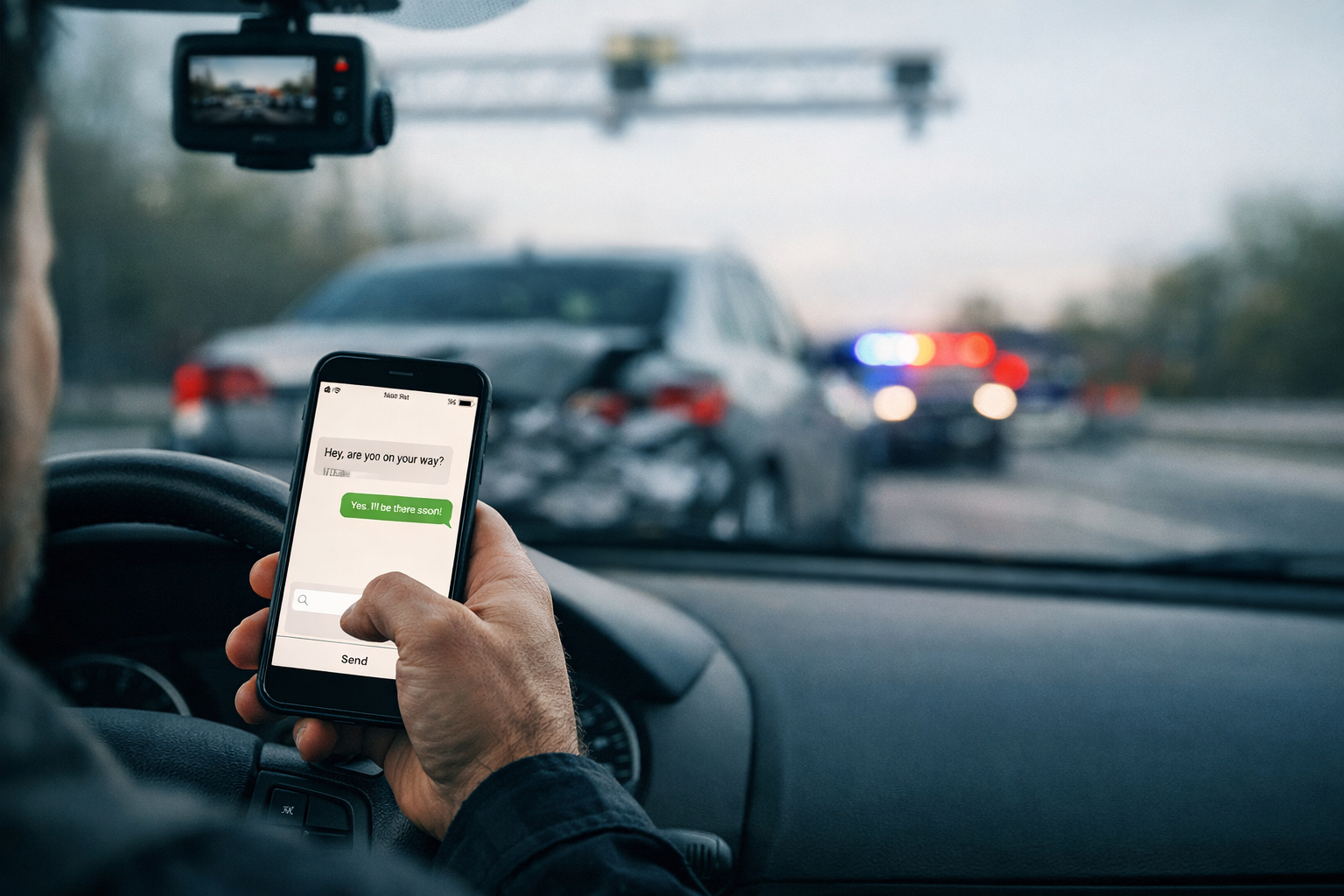
Drivers who cause crashes because they were using a phone rarely admit it. By the time police arrive, the device is often put away, notifications are cleared, and there is no obvious sign of distraction. Unlike an impaired driving case that may involve chemical testing, proving a texting-related collision usually depends on digital timestamps, vehicle data, and third-party observations gathered quickly and carefully.
Much of that evidence is temporary. Wireless carriers retain certain records for limited periods, traffic and surveillance cameras routinely record over old footage, and event data recorders store only a short window of pre-impact information.
In Hillsborough County cases, waiting too long can mean losing critical proof. If you believe the driver who hit you was distracted, speaking with a car accident attorney can help you determine what evidence may still be preserved and what steps should be taken next.
Key Takeaways About Distracted Driving Accidents in Tampa, Florida
- Florida law under Statute 316.305 prohibits manually typing into or reading data on a wireless device while operating a motor vehicle, and a violation may serve as evidence of negligence in a civil claim.
- Cell phone records, event data recorders, dashcam footage, and traffic camera video are among the strongest forms of evidence in a Tampa distracted driving case, but each has a limited preservation window.
- Under Florida’s modified comparative negligence system in Statute 768.81, the other driver’s distraction and your own degree of fault both factor into whether you recover compensation.
- Preservation letters sent to cell phone carriers and the at-fault driver’s insurance company help prevent the destruction of digital evidence that might otherwise be deleted.
- Florida’s two-year statute of limitations under Statute 95.11 applies to negligence-based car accident claims, but the practical deadline for preserving digital evidence is often much shorter.
What Does Florida Law Say About Texting and Driving?
Florida’s Ban on Texting While Driving Law, codified in Florida Statute 316.305, makes it illegal to manually type into or read data on a wireless communications device while operating a motor vehicle. A separate statute, Florida Statute 316.306, bans all handheld wireless device use in school zones and active work zones.
How Does a Texting Violation Factor Into a Tampa Car Accident Claim?
A traffic citation for texting while driving is not required to prove negligence in a civil case. However, if the other driver received a citation under Statute 316.305, that violation may serve as evidence that they failed to meet the standard of care required on Tampa roads.
What Activities Are Not Covered by the Florida Texting Ban?
The law includes specific exceptions that a defense attorney or insurance adjuster might raise. The following activities are not prohibited under Florida Statute 316.305:
- Using a wireless device in hands-free or voice-operated mode
- Operating a navigation or GPS system
- Receiving safety-related alerts, including emergency, traffic, or weather notifications
- Reporting an emergency or criminal activity to law enforcement
- Using a device while the vehicle is stationary, such as at a red light
An insurance company defending a distracted driver in Tampa may argue that the driver’s phone use fell into one of these exceptions. Cell phone records and forensic data from the device itself may help distinguish protected activity from prohibited manual use.
What Evidence Proves a Distracted Driving Accident in Tampa, Florida?
Proving distraction in a Hillsborough County car accident requires more than your word against the other driver’s. Physical evidence, digital records, and third-party testimony all play a role, and much of this evidence has a short shelf life.
Types of Evidence Used in Tampa Distracted Driving Cases
The strongest claims typically rely on more than one source of proof. These are the types of evidence most commonly used in Tampa distracted driving cases:
- Cell phone call detail records showing calls, texts, or data usage at timestamps matching the time of the collision
- Event data recorder information from the at-fault vehicle, capturing speed, braking, and steering input in the seconds before impact
- Dashcam footage from your vehicle or a nearby driver’s vehicle showing the other driver looking at their phone or failing to react
- Traffic camera or private surveillance footage from businesses near the crash site along corridors like Dale Mabry Highway or Hillsborough Avenue
- Eyewitness statements from passengers, other drivers, or pedestrians who observed the distracted behavior
No single piece of evidence proves a distracted driving case on its own. The strongest claims combine multiple sources that all point to the same conclusion.
How Do Cell Phone Records Work in a Florida Distracted Driving Case?
Call detail records from a carrier show the time of incoming and outgoing calls, text messages, and data usage. When those timestamps line up with the time of the crash, they create a strong connection between phone use and the collision.
Florida Statute 316.305 states that in any crash resulting in death or personal injury, billing records for a wireless device may be admissible as evidence, subject to the Florida Evidence Code and standard rules governing relevance and foundation.
Obtaining these records typically requires a subpoena, which means a lawsuit must be filed first, or a preservation letter must be sent to the carrier to prevent the records from being purged.
Why Does Evidence Disappear So Quickly After a Distracted Driving Accident?
The same technology that creates useful records also cycles through data at a pace that works against accident victims. These retention timelines create urgency that many Tampa residents do not realize until the data is already gone:
- Some carriers purge text message detail logs within days or weeks of transmission
- Call detail records may remain available for a year or more, depending on the carrier
- Traffic camera footage on Tampa roads is often overwritten on a rolling cycle measured in days
- Private business surveillance systems near a crash site typically record over existing footage within one to four weeks
- Vehicle event data recorder information may be overwritten if the vehicle is driven after the crash or if repairs begin before the data is downloaded
Each of these timelines runs independently, and none of them pause because you have an open insurance claim.
What Is a Preservation Letter and Why Does It Matter?
A preservation letter is a written notice sent to the other driver, their insurance company, or a cell phone carrier directing them to retain all records related to the crash. In Florida, once litigation is pending or reasonably foreseeable, the party holding relevant evidence has an obligation not to destroy it.
Failing to preserve evidence after receiving this notice may result in legal consequences known as spoliation sanctions. An attorney familiar with distracted driving claims typically sends these letters within days of a crash.
How Does Florida’s Comparative Negligence Law Affect a Distracted Driving Claim?
Even when the other driver was clearly distracted, the insurance company may still try to shift blame to you. Under Florida Statute 768.81, Florida follows a modified comparative negligence system that reduces your compensation by your percentage of fault and bars recovery entirely if your fault exceeds 50 percent.
What Fault Arguments Do Insurers Raise in Tampa Distracted Driving Cases?
Insurance adjusters in Hillsborough County regularly argue that the injured driver contributed to the accident. These are the arguments adjusters raise most frequently:
- Claiming you were exceeding the speed limit or driving too fast for conditions
- Arguing you followed the vehicle ahead too closely and did not leave adequate stopping distance
- Suggesting you failed to take evasive action, even though the distracted driver gave you no time to react
- Pointing to gaps in your medical records or delayed treatment as evidence that your injuries are not as serious as claimed
A strong record of the other driver’s phone use, combined with dashcam footage or witness testimony, limits the adjuster’s ability to inflate your share of fault. Every piece of evidence that places responsibility on the distracted driver reduces your exposure under Florida’s comparative negligence system.
What Damages May You Pursue After a Distracted Driving Accident in Tampa, Florida?
The financial toll of a distracted driving crash in Tampa extends well beyond the initial medical bill. These are the types of losses that Tampa car accident victims most frequently pursue:
- Medical expenses including emergency treatment, surgery, imaging, physical therapy, and ongoing care
- Lost wages from time away from work during recovery, as well as reduced earning capacity if the injuries limit your ability to perform your job long term
- Pain and suffering, which accounts for the physical discomfort and emotional toll of living with injuries caused by someone else’s negligence
- Property damage to your vehicle and personal belongings inside it at the time of the crash
Recovering any of these damages requires proof that the other driver’s distraction caused the accident and that your injuries resulted from that collision.
How Roman Austin Car Accident and Personal Injury Lawyers Approach Distracted Driving Claims in Tampa
A distracted driving accident claim in Tampa, Florida demands more than a police report and a phone call to the insurance company. It requires time-sensitive evidence collection and a strategy built around holding the distracted driver accountable. Roman Austin Car Accident and Personal Injury Lawyers represents Tampa car accident victims from the firm’s office at 401 E. Jackson Street, Suite 3319, Tampa, FL 33602.
Securing Digital Evidence Early
Roman Austin’s team moves quickly to send preservation letters to cell phone carriers, insurers, and other parties with access to relevant data. That early action helps protect call detail records and data usage information from being purged before anyone has a chance to review it.
Matching Phone Records to the Crash Timeline
Raw cell phone records do not tell a complete story on their own. Those records need to line up with the time of the collision as documented in the crash report, along with any available camera footage or vehicle data. Roman Austin coordinates that analysis so the evidence presents a clear picture of what the distracted driver was doing at the moment of impact.
Around-the-Clock Availability
Distracted driving crashes happen at every hour, and the process of preserving evidence does not wait for regular business hours. Roman Austin provides free consultations 24 hours a day, 7 days a week.
FAQs for Distracted Driving Accident in Tampa, Florida
How do I prove the other driver was texting when they hit me in Tampa?
Cell phone records from the other driver’s carrier may show calls, texts, or data usage at the time of the crash. Event data recorders, dashcam footage, traffic camera recordings, and eyewitness testimony may also support your claim. An attorney may subpoena these records once a lawsuit is filed or send a preservation letter to prevent deletion.
Are cell phone records admissible in a Florida car accident case?
Yes. Florida Statute 316.305 specifically allows billing records for a wireless device and testimony from authorities receiving messages to be admitted as evidence in any crash resulting in death or personal injury.
What is a preservation letter and why does it matter after a Tampa car accident?
A preservation letter is a written notice directing the at-fault driver, their insurer, or a cell phone carrier to retain all records related to the crash. Once a party receives this notice, they have an obligation under Florida law not to destroy relevant evidence.h
How long do I have to file a distracted driving accident claim in Tampa?
Florida’s statute of limitations for negligence-based personal injury claims is two years from the date of the accident under Florida Statute 95.11. However, the practical window for preserving digital evidence is much shorter. Acting within the first few weeks gives you the strongest chance of securing the evidence you need.
What if the other driver was not cited for texting while driving?
A traffic citation is not required to prove negligence in a civil car accident case. Cell phone records, dashcam footage, witness testimony, and other evidence may establish distraction even without a citation. The standard of proof in a civil case is lower than in a criminal proceeding.
How does comparative negligence affect my distracted driving claim in Florida?
Under Florida Statute 768.81, your compensation is reduced by your percentage of fault. If the other driver was texting but the insurer argues you were speeding, any fault assigned to you lowers your recovery. If your fault exceeds 50 percent, you are barred from recovering damages entirely.
Act Now to Preserve Evidence in Your Tampa Distracted Driving Accident Case
The proof you need to hold a distracted driver accountable exists right now, stored on a carrier’s server, a traffic camera hard drive, or a vehicle data recorder sitting in a tow yard. None of those systems are designed to wait for you.
Filing an insurance claim does not freeze those timelines, and neither does waiting to feel better before you take action. A free consultation with Roman Austin Car Accident and Personal Injury Lawyers gives Tampa residents a straightforward way to find out what evidence may still be available and what steps to take next.


