Being hit from behind feels like the clearest kind of crash, until the neck pain starts days later and the insurer calls it minor. A New Port Richey rear-end accident lawyer at Roman Austin can document those injuries properly and push back when the other side tries to shrink them.
We represent drivers and passengers hurt in rear-end collisions on US-19, State Road 54, Little Road, Ridge Road, and throughout west Pasco County. Consultations are free, our intake team answers 24/7, and you can call (727) 787-2500 whenever it suits you.
Is the Rear Driver Always at Fault in Florida?

The rear driver is usually presumed to be at fault in a Florida rear-end collision, but that presumption can be rebutted. Florida courts apply a rebuttable presumption that the trailing driver was negligent, and the Florida Supreme Court held in Birge v. Charron (2012) that the front driver's own negligence can still be considered under comparative fault.
Arguments Insurers Use Against the Front Driver
When the rear driver's insurer wants to share the blame, it usually argues one of these:
- The front driver stopped suddenly and without reason.
- The front driver's brake lights were not working.
- The front driver cut in too closely after changing lanes.
- The front driver reversed unexpectedly.
Under section 768.81, a driver more than 50% at fault recovers nothing, so even a weak argument deserves a strong answer.
Following Too Closely Under Florida Law
Florida law prohibits drivers from following another vehicle more closely than is reasonable and prudent, considering speed, traffic, and road conditions, under section 316.0895. A driver who cannot stop in time when traffic ahead slows was usually following too closely, whatever the reason the front car stopped. Officers often cite this statute after rear-end crashes, and the citation can support the civil claim even though it does not decide fault on its own.
Why Rear-End Crashes Happen on West Pasco Roads
Rear-end crashes often happen where traffic stops and starts unpredictably. In New Port Richey, that includes signal queues along US-19, turn lanes into shopping centers on State Road 54, and slowing traffic near school zones on Little Road.
Common driver errors include following too closely, phone use, and misjudging how quickly traffic ahead is stopping. Many of these crashes also overlap with our distracted driving cases.
Chain-Reaction Collisions
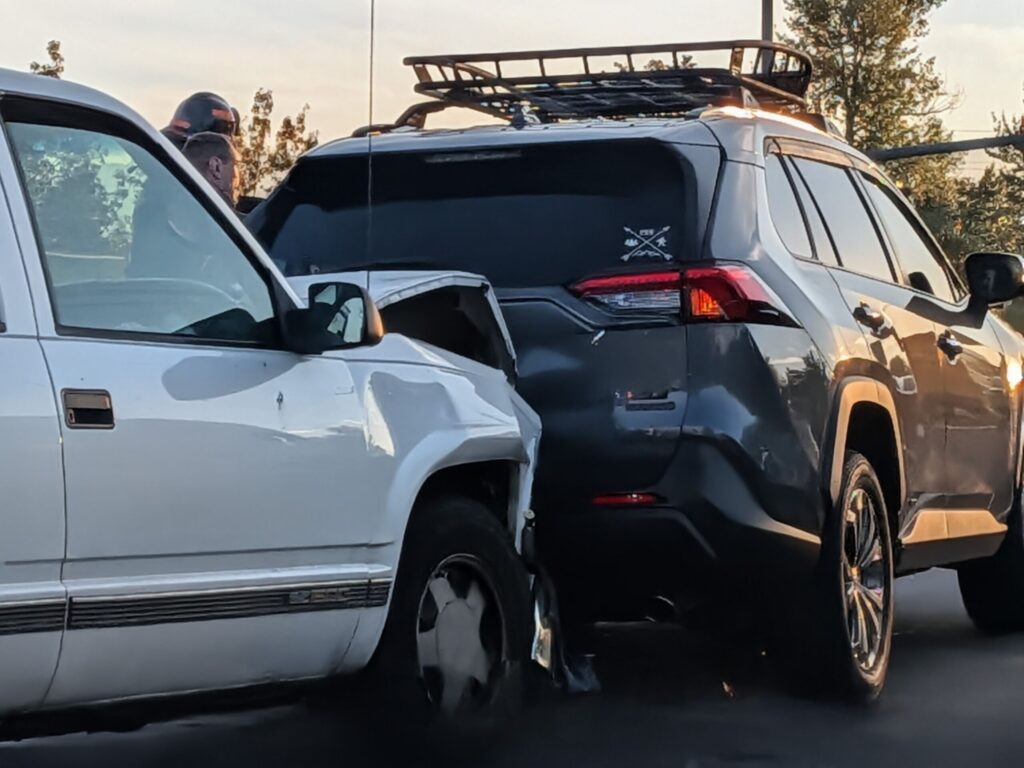
When one car pushes another into a third, fault may be divided among several drivers. Damage on both the front and rear of a middle vehicle helps a reconstructionist determine which impact happened first and which caused the injuries. These crashes sometimes happen near signals and share evidence issues with intersection crashes in New Port Richey.
Commercial Vehicles and Rideshare Rear-End Crashes
Rear-end crashes involving delivery vans, work trucks, or rideshare vehicles can add more insurance and more responsible parties. An employer may be liable for a driver who was working, and commercial vehicles often carry higher policy limits and onboard cameras or telematics that record speed and braking. Rideshare crashes involve insurance that depends on whether the driver was logged into the app or carrying a passenger. Identifying these sources early can make a meaningful difference when injuries are serious.
Whiplash and Soft-Tissue Injuries After a Rear-End Crash

Whiplash is a neck injury caused by the head snapping backward and then forward during a rear impact. It and other soft-tissue injuries are common in rear-end crashes, and symptoms such as stiffness, headaches, and shoulder pain sometimes appear a day or more after the collision.
Why Insurers Push Back on Soft-Tissue Claims
Soft-tissue injuries often do not show on X-rays, so insurers may argue the injury is minor or unrelated. Some rear impacts also cause disc herniations, concussions, or shoulder tears that only show up on MRI or specialist evaluation.
Consistent treatment and clear medical records are what separate a well-documented claim from one an adjuster dismisses.
Common Rear-End Injuries Beyond Whiplash
Whiplash is the best-known rear-end injury, but it is rarely the only one. The sudden back-and-forth motion and the force transferred through the seat can also cause herniated or bulging discs in the neck and lower back, concussions when the head strikes the headrest or snaps forward, shoulder injuries from the seat belt, and wrist or hand injuries from bracing against the steering wheel. Some people also develop jaw pain or persistent headaches after the crash.
Why Symptoms Can Appear Days Later
Many people feel shaken but mostly fine at the scene, then wake up stiff and sore a day or two later. Adrenaline can mask pain in the hours after a crash, and inflammation in injured soft tissue often builds over the following days. That delay is common, and it is one reason getting evaluated early, even when pain seems mild, helps protect both your health and your claim.
How PIP and the Injury Threshold Affect Rear-End Claims
Your own personal injury protection (PIP) pays first after a Florida rear-end crash. Initial treatment must happen within 14 days for PIP medical benefits, and benefits beyond $2,500 require an emergency medical condition determination under section 627.736.
To recover pain and suffering from the rear driver, you generally must meet the serious injury threshold in section 627.737(2), which includes a permanent injury within a reasonable degree of medical probability. That is often the central fight in a whiplash case.
How Medical Records Help Meet the Permanent Injury Threshold

Meeting Florida's permanent injury threshold usually depends on a clear, consistent medical record built over months, not a single diagnosis. In rear-end cases, three kinds of evidence tend to matter most.
Consistent Treatment Records
Regular appointments that document the same complaints over time show that an injury is real and ongoing. Gaps in treatment give insurers room to argue that you recovered or that something else caused your symptoms. If you have to pause care for work, cost, or family reasons, telling your providers why helps explain the gap in your records.
Imaging and Objective Findings
X-rays often look normal after a soft-tissue injury, so doctors may order an MRI when pain persists or radiates into the arms or legs. An MRI can show disc herniations, nerve compression, and ligament injuries that support a permanency finding. When imaging shows age-related changes, comparing it with any earlier scans can help show that the crash aggravated a condition that had not been causing problems before.
Permanency Opinions and Defense Exams
A treating physician typically gives the opinion that an injury is permanent within a reasonable degree of medical probability, often after you reach maximum medical improvement. Once a lawsuit is filed, the defense may request a compulsory medical examination under Florida Rule of Civil Procedure 1.360, performed by a doctor the defense selects. Preparing for that exam, and understanding that the defense doctor is not your treating provider, is part of protecting the claim.
| Claim stage | Who pays | What it requires |
|---|---|---|
| Early medical bills and lost wages | Your PIP | Treatment within 14 days |
| Medical costs beyond PIP | At-fault driver's liability coverage or your UM coverage | Proof of fault and damages |
| Pain and suffering | At-fault driver's liability coverage or your UM coverage | Meeting the serious injury threshold |
Results That Speak Directly to What We Do
Steps in a New Port Richey Rear-End Claim
Our approach to a rear-end claim focuses on early documentation and steady medical care:
- Confirm treatment began within 14 days and continues without unexplained gaps.
- Obtain the crash report from the New Port Richey Police Department, the Pasco Sheriff's Office, or the Florida Highway Patrol.
- Preserve both vehicles' event data, which can show the rear driver's speed and braking.
- Gather repair estimates and photos, even when damage looks minor.
- Present the claim once your doctors understand the long-term outlook, and file suit if needed.
Most negligence claims from crashes must be filed within two years under section 95.11(5)(a), with exceptions in certain situations.
What Happens After the Demand Is Sent
Once treatment has progressed far enough to understand the long-term outlook, we send a demand package to the at-fault driver's insurer with medical records, bills, imaging results, wage documentation, and physician opinions. The insurer reviews the claim and responds with an offer or a denial, and negotiation often follows.
If the insurer will not offer a fair amount, the next step is filing a lawsuit, usually in Pasco County, part of Florida's Sixth Judicial Circuit, where civil matters for west Pasco are heard at the West Pasco Judicial Center in New Port Richey. Litigation brings written discovery, depositions of the drivers and witnesses, the defense medical examination, and usually court-ordered mediation. Many rear-end cases resolve at mediation, while others proceed to trial.
Why Low Property Damage Does Not End the Claim
Insurers sometimes argue that a bumper with little visible damage means no one could be hurt. Modern bumpers are designed to absorb impact without showing it, and medical evidence, not repair cost alone, determines whether an injury occurred.
Why West Pasco Drivers Choose Roman Austin
Rear-end claims are common, which is exactly why insurers treat them as routine. We treat each one as the individual case it is.
- Founder Mark S. Roman is a Board Certified Civil Trial Lawyer through The Florida Bar.
- Our New Port Richey office on Seven Springs Boulevard serves west Pasco and Trinity.
- More than 1,200 clients have left our firm five-star Google reviews.
Rear-end crashes are one part of our work as New Port Richey car accident lawyers. Every claim depends on its facts. Call (727) 787-2500 for a free consultation.
FAQs: New Port Richey Rear-End Accident Lawyer
What if my neck pain started days after the crash?
Delayed neck pain after a Florida rear-end crash is common and does not prevent a claim. Getting evaluated within 14 days protects PIP benefits and creates a record linking the symptoms to the collision.
Can I recover if I was hit while stopped at a light?
A driver struck while stopped at a light in Florida usually has a strong liability claim against the rear driver. Recovery for pain and suffering still depends on meeting the serious injury threshold and on available insurance.
Who pays if the rear driver had no insurance?
If the rear driver had no bodily injury coverage, your own uninsured motorist coverage may pay damages beyond PIP, if you carry it. Many Florida drivers carry only the required PIP and property damage coverage.
Should I see a chiropractor or a doctor after a rear-end crash?
Florida PIP rules limit which providers can make an emergency medical condition determination, generally physicians, physician assistants, and advanced practice nurses. Seeing one of those providers early helps preserve the full PIP benefit.
Can a passenger in the front car file a claim?
Passengers in a car that was rear-ended can file their own claims, starting with PIP and then against the at-fault driver. A passenger is rarely at fault, which often simplifies the liability question.
Does a pre-existing neck or back problem hurt my rear-end claim?
A pre-existing neck or back condition does not prevent a Florida rear-end claim, because the law allows recovery when a crash aggravates an existing injury. Insurers often raise prior conditions, so earlier medical records and comparison imaging help show how the crash changed your symptoms.
What if the driver who hit me says I stopped suddenly?
A claim that you stopped suddenly does not automatically shift fault in a Florida rear-end crash, because drivers must leave enough room to stop safely. The rear driver would generally need evidence that your stop was abrupt, unexpected, and unreasonable, and dash camera footage or vehicle data often answers that argument.
Taking the Weight Off Your Shoulders

Attorney and Founder
A rear-end crash can leave you with pain that does not match the dent in your bumper. Roman Austin can build the record your claim needs and deal with the insurers on your behalf. Call (727) 787-2500, any hour, for a free consultation with our Pasco County car crash team.
Past results do not guarantee a similar outcome. Each case is unique and must be evaluated on its own merits.